

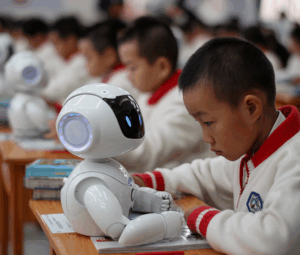
 On April 10, 2026, China launched its AI + Education plan. The announcement is not aimed at incorporating more technology into classrooms, but rather at redefining how it will educate its citizens: building the capacity to understand, develop, and govern artificial intelligence as the cornerstone of a new form of economic, social, and geopolitical power.
It is not just about training technical talent, but about preparing citizens capable of operating in a world defined by technology. To this end, China is not merely adjusting its education system—it is redesigning it. Curriculum, teacher training, management, infrastructure, and lifelong learning are becoming part of a new architecture.
The contrast is clear. While China is moving forward with large-scale capacity building, much of the world remains in the diagnostic phase or is still trying to understand the problem.
UNESCO warns that AI cannot replace the role of the teacher or reduce education to a technical process, though it acknowledges the urgency of fostering digital citizenship. The OECD argues that AI literacy will be a core competency and raises an uncomfortable question: what knowledge is worth teaching when machines already write, calculate, and respond?
But beyond the enthusiasm, the evidence remains limited. A Stanford study shows that only a small fraction of research studies manage to demonstrate improvements in learning. Although AI streamlines tasks and reduces administrative burdens, it also highlights a less visible risk: fostering superficial learning if not managed properly.
For Latin America, the starting point is even more fragile. Added to learning gaps are low levels of digital skills training and weak teacher preparation. We have made progress in access, but not in understanding, and even less in capacity building.
In this context, artificial intelligence ceases to be merely an educational challenge and becomes a geopolitical problem. In the knowledge economy, it is not enough to use technology: countries must be able to understand it, create it, and govern it. Otherwise, they will end up consuming what others design and participating in systems where the rules are already written.
Chile, however, has an opportunity that is rare in the region: it possesses capabilities, infrastructure, and a track record that position it better than other countries. But opportunities require leadership and investment, especially in educational innovation starting at an early age.
Because, while AI will bring speed and processing power, human value will continue to lie in judgment, empathy, creativity, and the ability to decide what to change and what to preserve.
The difference is simple: either we educate citizens capable of shaping technology… or we will end up being shaped by it—and by those who control it.
Mónica Retamal F.
Executive Director at Kodea