

 Global philanthropy is undergoing a profound shift. Major foundations—from the Ford Foundation to Gates, Skoll, and Co-Impact—agree that the problems of the 21st century require fewer pilot projects and more mature solutions. As Bill Gates has pointed out, today we need “a different combination of innovation, philanthropy, investment, and public policy, with a focus on human well-being.”
This standard contrasts with the reality in Latin America, where philanthropy represents only 0.2% of GDP, compared to 1.5% in the United States (The Resource Foundation, 2025). Although there are relevant institutions, funding tends to be discontinuous, short-term, and still too close to welfare. The result is a fragile ecosystem in which social organizations must sustain essential services with few resources and in territories where even the state does not reach.
Chile stands out in Latin America because long before social innovation became a trend, it already had NGOs capable of designing evidence-based solutions, scaling models, and responding to systemic problems. Teletón and COANIQUEM are global leaders in rehabilitation and burn treatment, respectively; Hogar de Cristo managed to transform methodologies into public policy; América Solidaria promoted South-South cooperation; Kodea leads in digital inclusion; Foro Innovación strengthened the entrepreneurial ecosystem; and TECHO Internacional operates in 18 countries with transitional housing models.
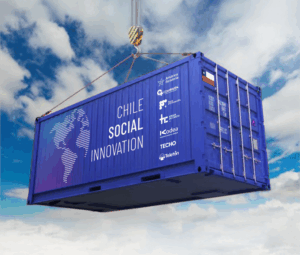
These institutions meet the standards required by global philanthropy today and, after a process of radical collaboration, have created Chile Social Innovation, the first sectoral seal in the region that articulates a portfolio with proven methodologies, traceability, and standards to convert this heritage into a strategic value for the country and the region. As Juan José Ayerza of TECHO International states, “the foundations are being laid for a deep collaboration, designed to scale up and address the social challenges of the continent, integrating innovation into every action and development.”
Issues such as climate change, secure AI, global health, persistent inequality, education for the future, and resilient democracies require mature projects, stable financing, and the ability to operate in complex systems. In light of this, Chile can act as a regional hub for social innovation, which requires better institutional capacities, more innovation and technology, robust evidence systems, and, of course, collaboration at all levels.
Latin America cannot continue to be seen only as a recipient of aid. If the region were to mobilize an additional 1% of large private capital assets, it would generate more than US$5 billion annually for social investment (The Resource Foundation, 2025) and—with role models such as Chile Social Innovation—this potential could be transformed into real impact, avoiding fragmentation and demonstrating that the South is also capable of innovation, scaling, and, above all, solving real social problems.